

Learn how to build a sustainable business strategy with real examples, environmental frameworks, and data-driven tactics for long-term SMB growth.
Table of Contents
If you only have a minute, here are the most important insights:
- A sustainable business strategy aligns profitability, environmental responsibility, and long-term resilience.
- Companies integrating sustainability into operations outperform peers by up to 21% in profitability (McKinsey, 2023).
- Environmental efficiency often reduces costs while improving brand reputation.
- Small and medium businesses can start with green hosting, efficient operations, and measurable ESG KPIs.
- Sustainability improves customer loyalty, talent attraction, and access to capital.
- Frameworks like Triple Bottom Line and Lean operations make sustainability practical and measurable.
Introduction
Businesses that dominate the next decade will not simply be the fastest growing. They will be the most resilient and adaptable. That resilience begins with a well-designed sustainable business strategy.
For small and medium businesses, sustainability is no longer a corporate buzzword reserved for multinational companies. It has become a core driver of long-term business growth, operational efficiency, and customer trust.
In this guide, you will learn:
- What a sustainable business strategy really means
- Practical environmental sustainability strategies for business
- How to integrate sustainability into daily operations
- Real-world sustainable business strategy examples
- Data-driven frameworks that turn sustainability into a competitive advantage
Everything here focuses on practical, measurable strategies for SMBs operating online.
What Is a Sustainable Business Strategy?
A sustainable business strategy is a long-term approach to growth that balances:
- Financial performance
- Environmental responsibility
- Social impact
Instead of focusing only on short-term revenue targets, sustainable strategy asks a broader question:
How can a business grow profitably while minimizing environmental impact and creating long-term value?
This shift reflects major changes in global consumer behavior.
According to the Nielsen Global Sustainability Report (2023), 73% of consumers say they are willing to change purchasing habits to reduce environmental impact. That makes sustainability a market opportunity, not just a compliance requirement.
For online businesses, sustainability can influence decisions such as:
- Hosting infrastructure
- Digital energy consumption
- Supplier selection
- Ethical sourcing
- Transparent data policies
When implemented correctly, sustainability becomes a core driver of trust and brand loyalty.
The Triple Bottom Line Framework
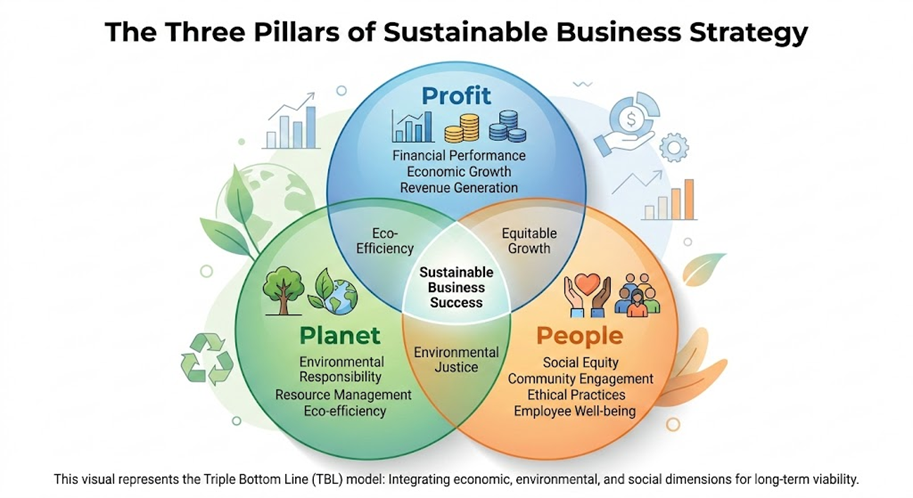
The most widely used sustainability framework is the Triple Bottom Line (TBL) model introduced by John Elkington.
It measures business success across three dimensions.
People
Focuses on social responsibility and stakeholder wellbeing:
- Fair labour practices
- Employee development
- Customer trust
- Community impact
Planet
Addresses environmental responsibility:
- Reducing carbon footprint
- Sustainable supply chains
- Waste reduction
- Energy efficiency
Profit
Ensures long-term financial sustainability:
- Healthy margins
- Operational efficiency
- stable revenue growth
For SMBs, the goal is not perfection. It is progress supported by measurable improvement over time.
Internal Link Suggestion
How to Build a Business Growth Plan →/business-growth-plan/
Sustainable Business Strategy Examples
Understanding sustainability becomes easier when examining companies that built successful models around it.
Below are three notable sustainable business strategy examples.
Patagonia: Sustainability as Brand Identity
Outdoor apparel company Patagonia integrated environmental activism directly into its brand strategy.
The company’s famous campaign “Don’t Buy This Jacket” encouraged customers to reduce unnecessary consumption.
Instead of reducing sales, the campaign increased customer trust and brand loyalty, strengthening long-term revenue.
Key lesson for SMBs:
Authentic sustainability messaging builds stronger customer relationships than traditional marketing.
Interface: Self-Financing Sustainability
Interface, a global flooring manufacturer, committed to eliminating its environmental footprint by 2020.
By 2019 the company had:
- Reduced carbon emissions by 96%
- Diverted 250 million kg of waste from landfill
These improvements also generated major operational savings.
Lesson: Sustainability improvements often pay for themselves through efficiency gains.
Ecosia: Purpose-Driven Business Model
Ecosia is a search engine that plants trees using advertising revenue.
Since launch, it has funded the planting of over 200 million trees worldwide.
Growth has been driven largely by word-of-mouth marketing and purpose alignment.
Lesson: Sustainability can become the core value proposition of a digital product.
| Traditional Model | Sustainable Model |
|---|---|
| Short-term profit focus | Long-term value creation |
| Resource intensive | Efficient operations |
| Transactional relationships | Purpose-driven loyalty |
Environmental Sustainability Strategies for Business
Environmental sustainability strategies are operational decisions designed to reduce environmental impact while maintaining profitability.
Fortunately, many strategies are easy for SMBs to implement.
Green Hosting and Digital Carbon Reduction
The internet produces approximately 3.7% of global carbon emissions, comparable to the aviation sector (The Shift Project, 2022).
Businesses can reduce their digital footprint by choosing hosting providers powered by renewable energy.
Examples include:
- GreenGeeks
- Kinsta
- SiteGround
This single decision can dramatically lower the environmental footprint of an online business.
Sustainable Supply Chain Practices
For companies selling physical products, supply chains represent the largest environmental impact.
Common sustainability improvements include:
- Using recyclable packaging
- Consolidating shipments
- Partnering with carbon-neutral logistics providers
- Vetting suppliers for environmental compliance
Service businesses also have supply chains through software tools, contractors, and vendors.
Selecting responsible partners reinforces sustainability commitments.
Energy Efficiency in Operations
According to the U.S. Department of Energy (2023), businesses can reduce energy costs by 10–30% through efficiency improvements alone.
Examples include:
- Remote-first work models
- Reduced travel
- Energy-efficient office spaces
- Optimized server infrastructure
Efficiency improvements reduce both costs and emissions simultaneously.
Integrating Sustainability into Business Strategy
Many companies treat sustainability as a marketing initiative rather than a strategic one.
True impact happens when sustainability becomes part of every major business decision.
Step 1: Conduct a Materiality Assessment
A materiality assessment identifies sustainability issues most relevant to stakeholders.
For example:
- E-commerce brands → packaging waste
- SaaS businesses → data privacy and energy usage
- Service companies → ethical sourcing and workforce policies
This process helps businesses prioritize the highest impact improvements.
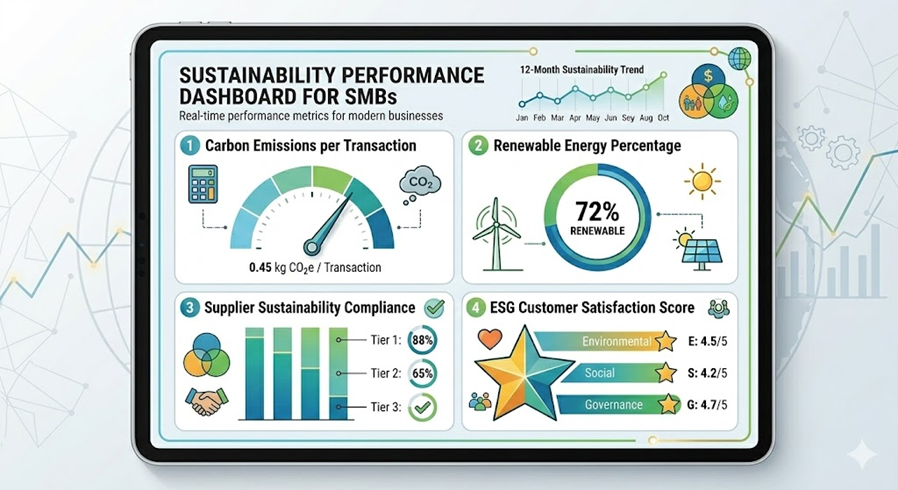
Step 2: Define Measurable Sustainability KPIs
Sustainability initiatives must be measurable.
Examples of useful KPIs include:
- Carbon emissions per product sold
- Percentage of renewable energy usage
- Sustainable supplier adoption rate
- Waste reduction targets
Tracking these metrics alongside financial KPIs reinforces sustainability as a performance indicator.
Step 3: Embed Sustainability in Decision Making
Every major decision should include a sustainability lens.
Questions to ask:
- What environmental impact will this decision create?
- Is there a more sustainable alternative?
- Can efficiency improvements offset the cost?
This approach gradually builds long-term competitive advantage.
Internal Link Suggestion
Data-Driven KPI Dashboard for Small Businesses →/kpi-dashboard-small-business/
Performance Improvement Strategies for Sustainability
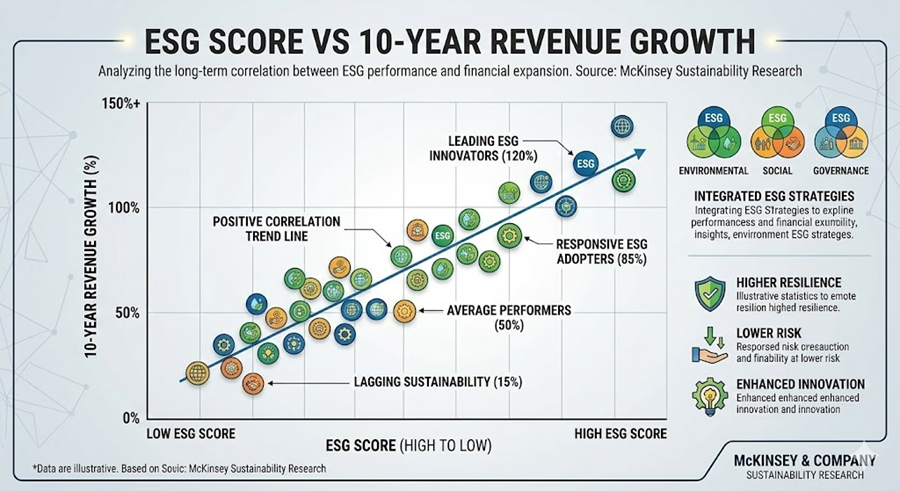
Contrary to popular belief, sustainability does not reduce profitability.
In many cases, it improves financial performance.
Sustainability and Profitability
A Harvard Business School meta-analysis covering 2,000+ studies found that companies with strong sustainability practices demonstrate:
- Better operational performance
- Lower financial risk
- Stronger long-term profitability
McKinsey (2023) also found that companies with strong ESG performance outperformed peers by 3–5% annually in shareholder returns.
Lean Operations as a Sustainability Framework
Lean management eliminates operational waste.
This approach naturally aligns with sustainability.
Key lean principles include:
- Eliminating unnecessary processes
- Reducing inventory waste
- Improving workflow efficiency
- Continuous improvement cycles
For SMBs, lean operations reduce costs while minimizing environmental impact.
Purpose-Driven Customer Loyalty
Research from Cone Communications (2023) found:
- 87% of consumers purchase from companies supporting causes they care about.
- 76% avoid brands whose values conflict with theirs.
Customers aligned with brand values also demonstrate:
- Higher lifetime value
- Lower churn
- Greater referral activity
Purpose-driven branding therefore strengthens long-term revenue stability.
Sustainability as a Competitive Advantage
Businesses that adopt sustainability early build advantages competitors struggle to replicate.
Talent Attraction
According to the Deloitte Global Millennial Survey (2023):
- 49% of millennials consider environmental impact when choosing employers.
A credible sustainability program therefore improves recruitment outcomes.
Access to Capital
Financial institutions increasingly support sustainability initiatives.
Examples include:
- Green loans
- Impact investment funds
- ESG-linked financing
Businesses demonstrating sustainability metrics may receive preferential lending terms.
Regulatory Readiness
Environmental regulations are tightening globally.
The EU Corporate Sustainability Reporting Directive (CSRD) introduced in 2024 expands reporting requirements across supply chains.
Businesses that prepare early avoid costly compliance disruptions later.
Sustainable Business Strategy Online Course
For business owners seeking structured learning, several excellent sustainable business strategy online courses exist.
Recommended Courses
Coursera — Sustainable Business Strategy (Harvard Business School Online)
Comprehensive program explaining the link between sustainability and financial performance.
edX — Business and Climate Change (University of Edinburgh)
Focused on climate strategy and operational sustainability.
LinkedIn Learning — Sustainability Foundations
Short introduction ideal for entrepreneurs and SMB founders.
Certifications Worth Considering
B Corp Certification
Recognized globally for measuring social and environmental performance.
ISO 14001
International environmental management standard used by enterprise suppliers.
Both certifications strengthen credibility and stakeholder trust.
Short educational overview of sustainability frameworks.
Advanced Strategy
Once foundational practices are established, companies can apply data-driven frameworks to scale sustainable growth.
ESG Attribution Modeling
Businesses can track which sustainability initiatives deliver the highest return.
Metrics may include:
- CO2 reduction per dollar invested
- Waste reduction impact
- supplier compliance improvements
Ranking initiatives by impact-to-cost ratio improves strategic decision making.
Predictive Customer Analytics
Customers engaging with sustainability messaging often show lower churn rates.
CRM systems can track behaviors such as:
- Sustainability content engagement
- eco-friendly product purchases
- participation in brand initiatives
Predictive models identify high-value customers and improve retention strategies.
Lifecycle Assessment
Lifecycle Assessment (LCA) measures environmental impact across a product’s entire lifecycle.
This includes:
- raw material extraction
- manufacturing
- distribution
- usage
- disposal
Even simplified LCA tools can help SMBs identify high-impact improvement opportunities.
References
McKinsey & Company — Sustainability and Financial Performance (2023)
https://www.mckinsey.com
Nielsen Global Sustainability Report (2023)
https://nielseniq.com
U.S. Department of Energy — Business Energy Efficiency
https://energy.gov
Harvard Business School Online — Sustainable Business Strategy
https://online.hbs.edu
Conclusion
A sustainable business strategy is no longer a corporate trend. It is becoming a core requirement for long-term growth and resilience.
Businesses that integrate sustainability into their operations gain multiple advantages:
- Lower operational costs
- stronger customer loyalty
- improved talent recruitment
- better access to capital
For small and medium businesses, the path forward is clear.
Start with simple steps:
- adopt sustainable infrastructure
- measure environmental impact
- align operations with long-term value creation
Over time, these improvements compound into a powerful competitive advantage.
Ready to build a sustainable business strategy for your company?
Start by auditing your current operations, identifying improvement opportunities, and implementing measurable sustainability KPIs that drive long-term growth.