
Learn how to create a powerful business growth plan for your online business. Follow this step-by-step guide to grow traffic, customers, and revenue.
Table of Contents
Business Growth Plan: The Step-by-Step Blueprint for Online Business Growth
Most online businesses struggle to grow for one simple reason.
They do not have a clear business growth plan.
Without a growth plan, you are simply guessing. You publish content, run ads, or try new tools. But nothing connects into a real strategy.
A business growth plan solves this problem.
It shows:
- Where your business is going
- How you will get there
- What actions you must take every week
In this guide, you will learn:
- What a business growth plan is
- Why most online businesses fail without one
- The key parts of a strong growth plan
- Proven strategies that grow online businesses
- A simple step-by-step framework you can follow today
If you want consistent online growth, this guide will help.
What Is a Business Growth Plan?
A business growth plan is a clear strategy that explains how a business will increase revenue, customers, and market reach.
Think of it like a roadmap.
Without it, your business moves in random directions.
With it, every action supports growth.
Unlike a traditional business plan, a growth plan focuses on scaling the business, especially online.
It is also a living document. Successful businesses review it every 90 days.
Why Most Online Businesses Fail Without a Growth Plan
Many founders focus on tools and tactics.
They try:
- SEO
- social media
- Ads
- email marketing
But without a strategy, these efforts do not work together.
This leads to:
- inconsistent traffic
- slow revenue growth
- wasted marketing budget
A clear business growth plan fixes this problem because it forces you to answer important questions:
- Who is the ideal customer?
- What is the revenue goal?
- Which marketing channels will drive growth?
- What metrics define success?
Once these questions are clear, growth becomes easier to manage.
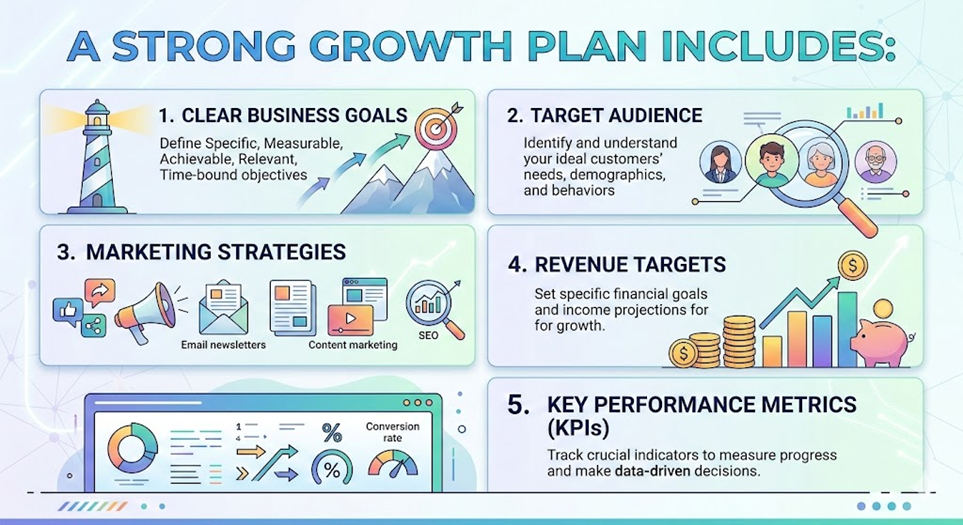
Key Parts of a Business Growth Plan
A strong business growth plan does not need to be 40 pages long.
In most cases, 6 core sections are enough.
1. Executive Summary
This section explains your business in a few short paragraphs.
Include:
- What your business does
- Who your customers are
- Your main growth goal for the next 12 months
This keeps the entire strategy focused.
2. Market Analysis
Before growing, you must understand the market.
Study:
- your target audience
- competitors
- market trends
- customer needs
For online businesses, tools like:
- Google Trends
- keyword research tools
- competitor websites
can reveal valuable insights.
This research helps you find opportunities your competitors missed.
3. Revenue Goals
Growth requires clear numbers.
Instead of saying “grow revenue,” define a measurable target.
Example:
Increase monthly revenue from $5,000 to $20,000 in 12 months.
Clear targets guide your strategy.
4. Growth Strategies
This section explains how the business will grow online.
Choose a few focused channels.
For most online businesses, the strongest channels include:
- SEO and content marketing
- email marketing
- partnerships
- social media distribution
- referral marketing
Avoid trying everything at once.
Focus on 2–3 main channels.
5. Operational Plan
Growth brings more customers.
Your systems must support that growth.
Your plan should outline:
- tools you will use
- processes for customer support
- automation systems
- team responsibilities
Early system organization allows online businesses to scale faster.
6. Key Performance Indicators (KPIs)
KPIs track whether the growth plan is working.
Common KPIs for online businesses include:
- website traffic
- conversion rate
- customer acquisition cost
- monthly revenue growth
- customer lifetime value
Tracking these metrics helps you make better decisions.
Business Growth Plan Stages
Most businesses pass through predictable growth stages.
Understanding them helps you choose the right strategy.
Stage 1: Startup
At this stage, the focus is validation.
Goals include:
- Finding your first customers
- Testing your product or service
- Improving your offer
The main goal is product-market fit.
Stage 2: Early Growth
You now know what works.
The focus becomes repeatable growth.
You double down on the marketing channels bringing customers.
SEO and content marketing often become powerful here.
Stage 3: Scaling
Your business is growing quickly.
Now the goal is expansion.
You may:
- invest in marketing
- hire support
- build stronger systems
This stage requires clear data and disciplined execution.
Stage 4: Maturity
Growth slows because the market becomes competitive.
At this stage, businesses focus on:
- customer retention
- upsells
- partnerships
- product expansion
Stage 5: Renewal
Markets change constantly.
Businesses must innovate to stay competitive.
This may involve:
- new products
- new audiences
- new distribution channels
Proven Strategies for Online Business Growth
Many growth tactics exist, but only a few consistently work.
Here are the most effective ones.
1. Content Marketing and SEO
Content marketing is one of the most powerful long-term strategies.
Every article you publish becomes a 24/7 traffic source.
A strong SEO strategy includes:
- keyword research
- high-quality blog content
- internal linking
- backlink building
Over time, this creates steady organic traffic.
2. Customer Retention
Many businesses focus only on new customers.
But keeping existing customers is more profitable.
Retention strategies include:
- email newsletters
- loyalty programs
- customer communities
- follow-up offers
Even small improvements in retention can increase revenue significantly.
3. Product Expansion
You can grow revenue by creating additional offers.
Examples include:
- premium services
- online courses
- consulting packages
- subscription products
This allows you to generate more revenue from existing customers.
4. Strategic Partnerships
Partnerships can unlock faster growth.
Partner with businesses that serve the same audience.
Examples include:
- co-marketing campaigns
- guest content collaborations
- affiliate partnerships
This helps you reach new customers without large marketing costs.
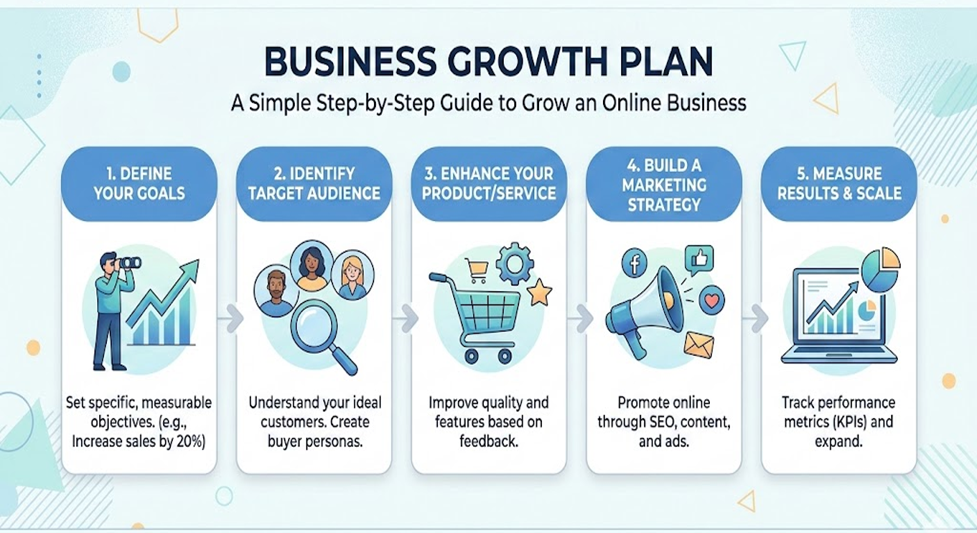
How to Create a Business Growth Plan (Step-by-Step)
You can create your first business growth plan in one afternoon.
Follow these steps.
Step 1: Run a SWOT Analysis
Identify your:
- Strengths
- Weaknesses
- Opportunities
- Threats
This gives you a clear picture of your current position.
Step 2: Define a 12-Month Goal
Choose one main outcome.
Examples include:
- reach $100K revenue
- acquire 1,000 customers
- grow website traffic to 50K monthly visitors
Focus on one measurable goal.
Step 3: Choose Three Growth Channels
Do not spread your efforts everywhere.
Choose three channels that will drive the most growth.
For many online businesses, these are:
- SEO
- email marketing
- partnerships
Step 4: Create a 90-Day Action Plan
Break your goal into smaller steps.
Define:
- weekly tasks
- marketing campaigns
- content schedule
Short planning cycles keep momentum strong.
Step 5: Track KPIs
Set up a simple dashboard.
Review your numbers weekly.
If something is not working, adjust quickly.
Growth requires continuous learning.
Example of a Business Growth Plan (Online Business)
Here is a simplified example.
Goal:
Increase monthly revenue from $5,000 to $15,000.
Primary Channel:
SEO content targeting industry keywords.
Secondary Channel:
Email newsletter with weekly value content.
Retention Strategy:
Offer premium training programs to existing subscribers.
KPIs:
- website traffic
- email subscriber growth
- conversion rate
- monthly revenue
- Even a simple plan like this creates clarity.
Final Thoughts
A business growth plan is not optional for online businesses.
It is the difference between random effort and predictable growth.
The most successful online businesses share three habits:
- clear strategies
- disciplined execution
- data-driven decisions
You do not need a perfect plan.
You only need a clear starting point.
Block a few hours this week and create your first business growth plan.
Your future growth will depend on it.
Business Growth Plan FAQs
How often should a business growth plan be updated?
Successful businesses review their growth plans every 90 days and adjust strategies based on performance data.
What is the purpose of a business growth plan?
A business growth plan helps companies define goals, choose marketing strategies, and track progress toward revenue growth.
How long should a business growth plan be?
Most effective growth plans are 5–10 pages. The focus should be clarity, not length.